The Ideal Weekly Schedule for a 6-Figure Solopreneur

Time management for solopreneurs is a totally different game than time management for people with 9–5 jobs. As a service provider, you don’t have a boss, a fixed schedule, or built-in external accountability telling you when to start, stop, or switch tasks. And that’s exactly why most advice about time management for business owners completely falls apart for us.
I remember my early days as a solopreneur desperately wishing I could be a fly on the wall and see a real weekly schedule example from other service providers. Not a color-coded fantasy calendar—but an actual weekly schedule for business owners who were booking clients, delivering services, and still trying to have a life.
Because planning your week as an entrepreneur isn’t just about filling time. It’s about constantly deciding what deserves your attention, when client work should happen, and how to organize your calendar without feeling like you’re always behind.
If you’ve ever wondered:
-
How to manage your time as an entrepreneur without working nonstop
-
How to plan your day as an entrepreneur when every task feels important
-
How to balance client work, marketing, admin, and thinking time
-
Or how to manage your time as a business owner when there’s no clear finish line
You’re in the right place.
In this post, I’m breaking down time management for solopreneurs specifically through the lens of service providers—so you can stop guessing, start making intentional decisions about your week, and finally build a schedule that actually supports your business and your energy.
In this post you’ll learn the ideal calendar for solopreneurs including:
-
Why traditional productivity systems fail creative solopreneurs and service providers
-
The real reason you still feel behind (even when you’re “productive”)
-
The 4 essential types of work every business owner must make time for
-
How to build a weekly schedule that reflects your actual life and business
-
What a “work container” is—and how it can instantly reduce overwhelm
-
How to reverse engineer your calendar from your goals (instead of guesswork)
And if you want to dive deeper I invite you to grab my Time Puzzle Workshop and free 10 Calendar Commandments resource—both of which are linked throughout this post.
Listen to the podcast episode for this blog post:
Why Most Weekly Calendars Don’t Work for Entrepreneurs
Most of the time management advice out there is made for corporate employees. Rigid systems, color-coded every-15-minutes calendars, and strict routines that collapse the second life throws you a curveball.
But we’re solopreneurs. We work from home. We don’t have a boss. Our schedules are irregular. Client projects change. Revisions come in. You wake up and literally forget what you do for a living after the holidays.
In short? Time management for solopreneurs and service providers requires it’s own system!
Here’s the fantasy we’ve all had:
“I just want someone to tell me what to do and how to organize my time. I want to open my laptop on Monday and know exactly what to work on.”
We’ve never been taught to build a calendar around your actual business model.
This is where my Time Puzzle philosophy comes in.
Here is the weekly calendar formula for service providers:
Step 1: Define Your Weekly Work Schedule
In short? You need to decide when you actually work.
I like to refer to this as your “work container”.
Before you worry about how to plan your day as an entrepreneur, you need to know how much time you actually have.
In order to do that, I like to create a simple visual on a spreadsheet (I use Google Sheets) like this:
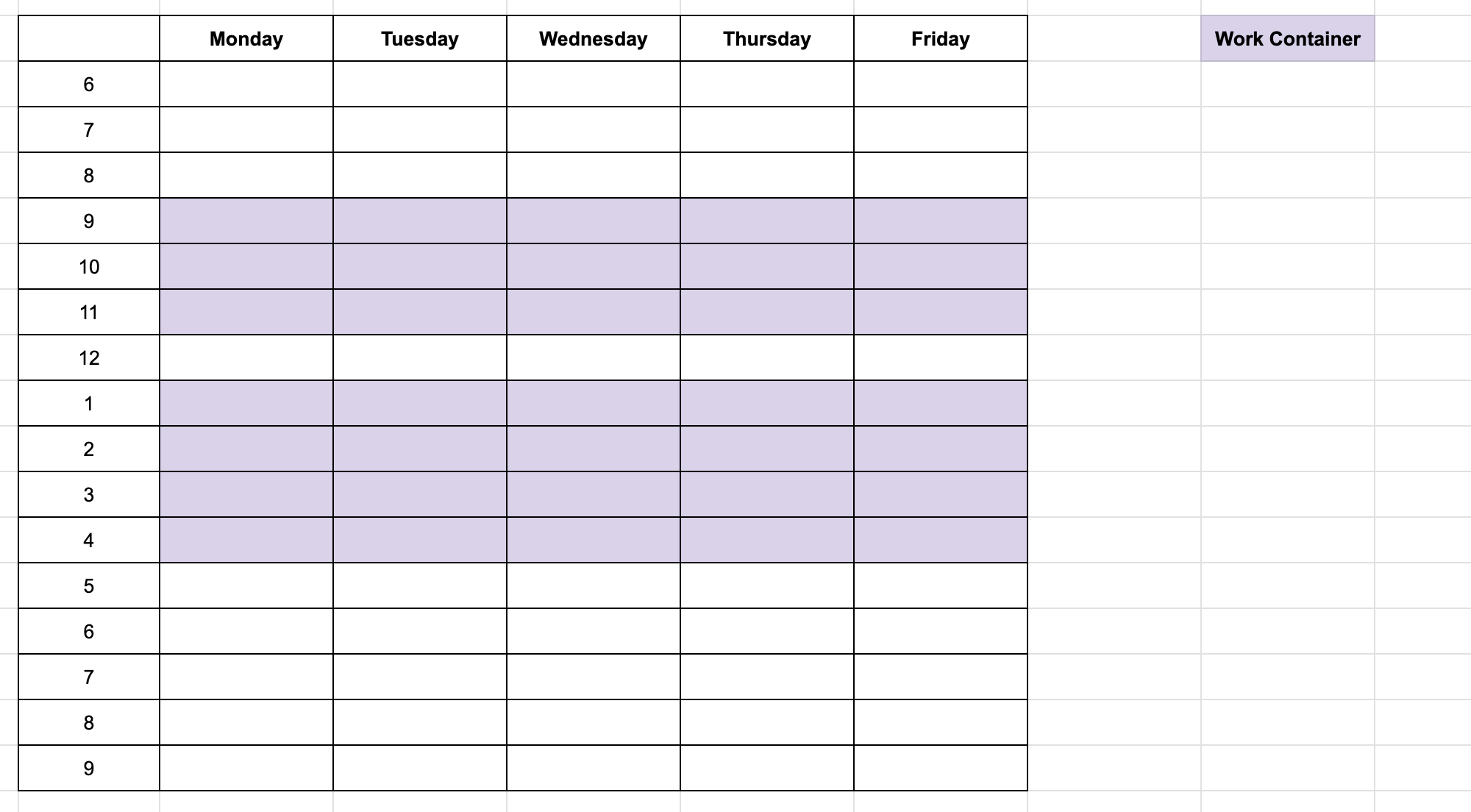
The purple boxes represent the “work container” in the above example.
This is one of the first exercises I walk you through in the Time Puzzle Workshop, and it’s a total game changer because it’s SO simple.
The rule is that all of your work has to fit inside of this container. No leaking!
That said, if your work starts to leak out of the container regularly, that’s a clear sign that it’s time to analyze what’s on your plate and make some intentional decisions.
Important Note: It doesn’t matter how many hours per week you have in your container. Whether that’s 5 hours or 40 hours, your job is to fit your priorities into that, not the other way around.
Step 2: Know the 4 Functions of Your Business
One of the big mistakes solopreneurs make is thinking their #1 job is doing client work. Because of this, you are over-booking and under-charging and don’t have enough time to do the other things that need to happen in your business.
These are the 4 buckets that every task in your business (and therefore Time Puzzle) must fit into.

Function #1 – CEO Time: Big picture thinking, planning, learning, and strategic decisions
Function #2 – Marketing (and Sales): Content, discovery calls, applications, driving leads
Function #3 – Delivery: Your actual service work (what clients pay you for)
Function #4 – Operations: Admin, tech, systems, financials, and all the behind-the-scenes stuff
Every single thing that happens in your business fits into one of those buckets! These are absolutely essential elements to consider in any time management for solopreneurs system.
Step 3: Make a list of everything you need to do in each of the 4 functions
What are all of the things that you need to do in your business to keep it growing towards your goals?
Here are some examples of work that fits into each category:
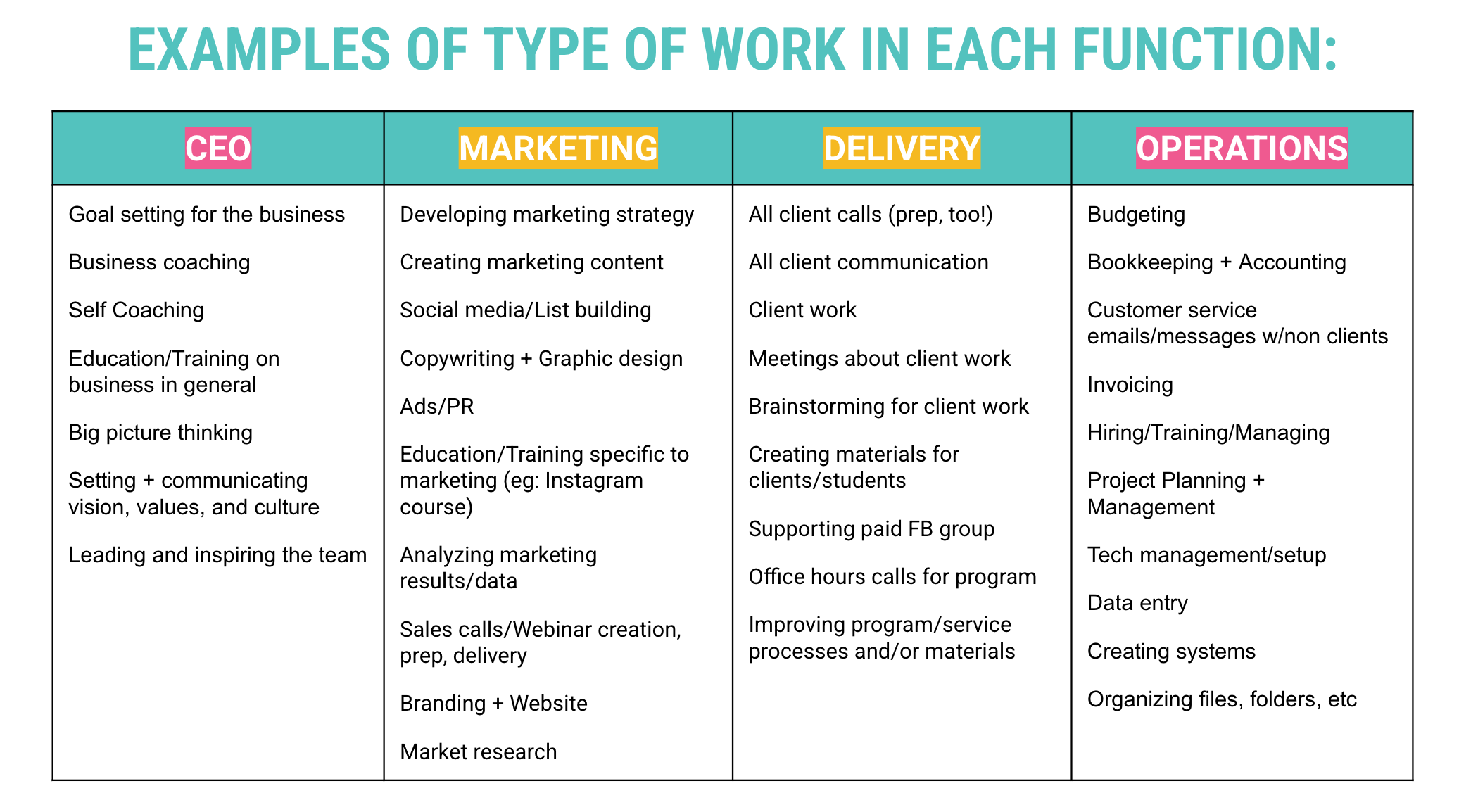
That said, you’ll need to make a list of all of the ongoing (daily, weekly, monthly, quarterly, annual, project-based) tasks that need to happen to keep your busienss running. (I can help you do that in the Six Figure Time Puzzle workshop).
Step 4: Add them to your weekly calendar
Now it’s time to make sure that there is space for everything on your weekly calendar.
Here’s a weekly schedule example that you can start with:
- Monday: CEO Time — Review your week, reflect, plan, dream, read
- Tuesday: Marketing & Sales — Record content, send emails, post strategically
- Wednesday: Delivery — Client calls, project execution, revisions
- Thursday: Operations — Admin, finances, checking in on systems
- Friday: Overflow or buffer (or ideally, OFF)
Here’s what that would look like on your weekly calendar:
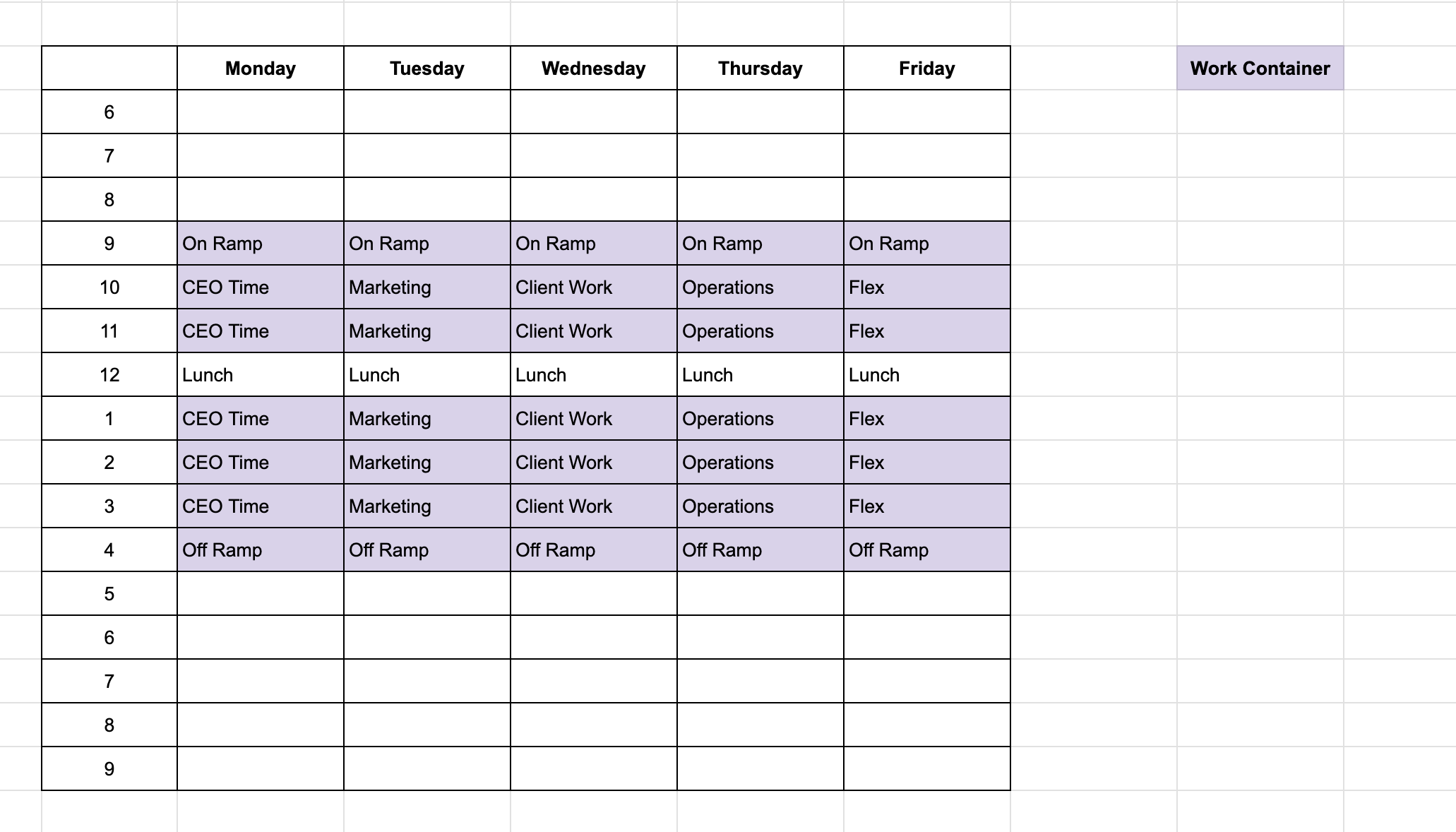
Notice that each daily schedule example is focused on one of the functions. This is to be efficient with your energy.
However, you don’t have to split up your daily work schedule like this.
You can batch these or split them up based on your unique energy.
The point is that everything you do should fall into one of those four categories—and you should know which block it belongs to.
Still need help building your weekly schedule?
I’ve got you covered! I go over the rules for how I map out my blocks of time in the 10 Calendar Commandments (it’s free!)
Step 5: Fill in your actual tasks/responsibilities
So what are you actually going to do during each of these daily time blocks?
The answer is going to depend on your specific projects, business model, etc.
Warning: If you do not clearly decide what to do during these time blocks they will get filled with busy work that feels productive but isn’t actually helping you hit your goals.
Then, in order to reverse engineer your goals onto your calendar, you need to know:
A) Your business goals for the year
B) The specific projects and tasks you need to implement to achieve those goals
C) How much time each of those things takes
This is exactly what I do with my Six Figure Sprint clients using the curriculum from my course, Yay for Clients.
Remember: The goal of your weekly schedule is not productivity. The goal is to make progress towards your goals.
If you follow the steps I’ve outlined above, you’ll have a weekly schedule for your business that covers everything that matters and nothing that doesn’t.
You now know how to:
- Define your weekly work schedule (or as I like to call it your “work container”)
- Get clear on the 4 functions of your business and everything that needs to happen in each of those functions
- Identified when you will focus on each of the 4 functions during the week
- Plug in the exact tasks that need to happen in each of those work blocks
Now it’s time to put it all into action and customize it for your business!
This is exactly the work we do inside the Time Puzzle Workshop.
Take action:
- Grab the FREE 10 Calendar Commandments to set up your own sustainable weekly rhythm
- Read next: How I Finally Mastered Time Management as an ADHD Entrepreneur
- HIGHLY RECOMMEND: Get the Time Puzzle Workshop to learn my complete time philosophy and how to build and use your time puzzle.
- Apply for the Six Figure Sprint when you’re ready to turn your services into a system that books dream clients on repeat