The Solopreneur Myth: Why Your Business Still Depends on You
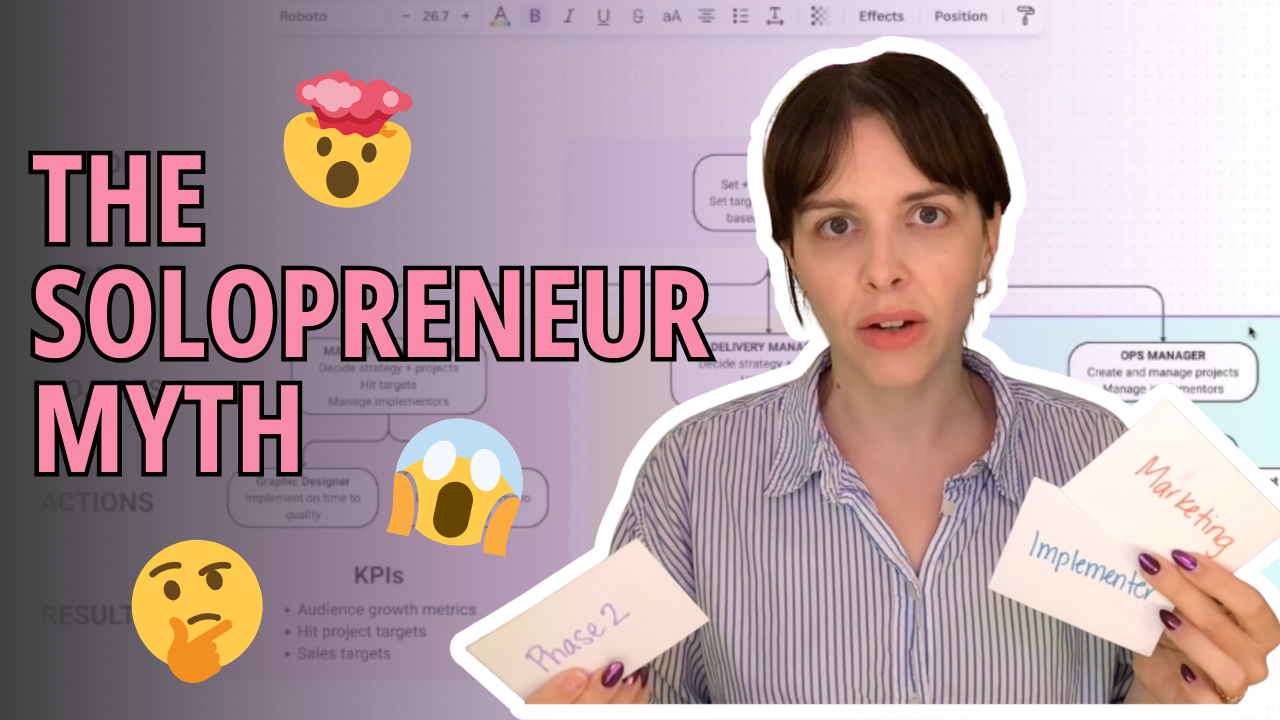
Let’s be real: most service providers don’t actually have a business.
They have a very demanding job they created for themselves.
If you stopped working for two weeks and nothing would happen — no sales, no progress, no momentum — that’s the tell. That’s not freedom. That’s a system that only works when you’re actively pushing it forward.
And the frustrating part? This way of building has been completely normalized in the online business world, especially for women and service providers. We’re told that this is just “how it works” when you’re self-employed. That being tired is part of the deal. That everything relying on you is normal.
It’s not.
The issue isn’t that you’re not working hard enough. It’s that most of us were taught to think about business way too small.
You can read, listen to, or watch this episode!
Watch the video on YouTube here:
Listen to the podcast episode here:
Listen to the Yay for Business Podcast on Spotify or Apple Podcasts
You Built a Business Around Yourself (Of Course You Did)
When you started your business, you probably did it because you loved the work. You were good at something — coaching, copywriting, design, strategy — and you wanted to do more of it without a boss.
So you built a business around you.
Your expertise became the product. Your energy became the engine. Your presence became the system.
At first, that feels empowering. You’re booked. People want you. You’re essential.
But over time, that “essential” feeling turns into pressure.
Because now everything depends on you. You can’t take time off without stress. You can’t step back without everything slowing down. And no matter how “successful” it looks from the outside, it feels fragile on the inside.
That fragility is the clue.
Passion is not a sustainable business strategy. Your motivation will fluctuate. Life will happen. And if your business only works when you’re operating at full capacity, it’s not a business. It’s something that survives on effort.
What a Real Business Actually Requires
A real business isn’t defined by how hard you work. It’s defined by how it functions without constant effort.
And this is where most service providers get tripped up: they think their job is delivering the service. But delivery is only one function of a real business.
Every business has multiple functions, whether you consciously design them or not. There is vision and direction. There is marketing and sales. There is delivery. And there are operations — the systems, documentation, and structure that make everything run smoothly.
Most service providers collapse all of those functions into one person and one mode of working: implementation.
They are constantly doing.
Creating content. Selling. Delivering to clients. Answering emails. Making strategic decisions mid-task. Changing offers while writing sales pages. Adjusting pricing on the fly.
And then wondering why everything feels chaotic.
Why Everything Feels Reactive (And Why It’s Not a Time Management Problem)
It’s not that you need a better planner.
It’s that you’re mixing roles that were never meant to be mixed.
In a real business, there are levels to how work happens. There’s the CEO level, where decisions about direction and priorities are made. There’s the manager level, where plans are created and systems are built. And there’s the implementer level, where tasks are executed.
Most service providers live almost entirely at the implementer level, while making CEO-level decisions in the middle of doing tasks.
That’s why everything feels reactive. That’s why nothing sticks. That’s why you feel like you’re constantly rebuilding instead of building.
When you don’t separate those roles, your business becomes personality-driven instead of structure-driven. It runs on mood instead of systems.
And that’s exhausting.
The Shift: From Doing the Work to Building the Machine
Your job as a business owner is not to do everything forever. Your job is to build the machine — even if you still choose to operate inside it.
This doesn’t mean you need a massive team or a million-dollar company. It means you need to stop designing something that only works when you’re exhausted and present.
The moment your business cannot exist without you, it becomes risky. Not because you’re replaceable, but because no system should rely entirely on one human functioning perfectly all the time.
The shift isn’t about scaling faster. It’s about building intentionally.
Start asking different questions:
-
What role am I in right now?
-
Is this a CEO decision or an implementer task?
-
Is this system dependent on me as a person, or on a clearly defined role?
When you start thinking this way, everything changes. You stop optimizing how much you can personally handle and start designing something that can actually support you.
You don’t lose control by building structure.
You gain freedom.
TL;DR: If You Want a Real Business, Build One
If you’re feeling trapped by something you built for “freedom,” here’s where to start:
-
Stop identifying your value with doing the work.
-
Separate CEO thinking from implementation.
-
Document how things are done.
-
Build systems before you build scale.
-
Design your business so it can function without constant effort.
Because the goal isn’t to be indispensable.
The goal is to build something that works — with or without you.