How I Finally Mastered Time Management as an ADHD Entrepreneur
If you’ve ever looked at your calendar and thought, “I should be able to do this… so why am I not doing it?”…
…this post is for you.
I’ve spent years trying every productivity hack under the sun.
Color-coded Google calendars.
Pomodoro timers.
Task batching.
None of it really worked for my unpredictable, creatively chaotic, ADHD-entrepreneur brain.
Until I created a calendar-based productivity system that actually works — not just for me, but for the solopreneurs and service providers I coach every day.
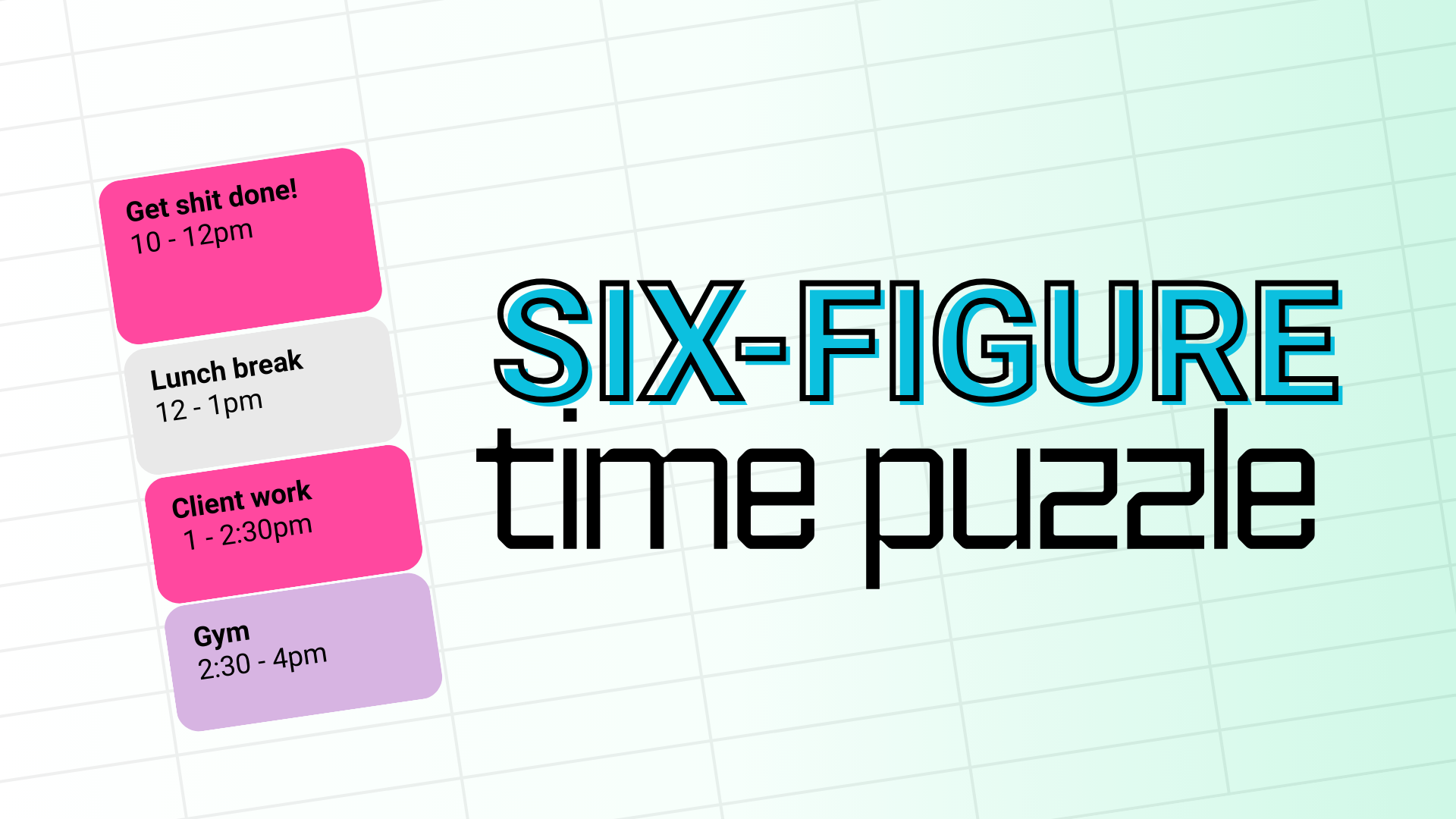
I call it “The Time Puzzle”. And it’s changed my life.
In this post, I’m breaking down the key mindset shifts, calendar commandments, and ADHD-friendly systems I used to have my most productive (and profitable) year ever — while parenting two small kids and running a multiple six-figure business.
Listen to the podcast episode here:
Why Most Productivity Systems Fail Entrepreneurs
Let’s get real for a second: Most productivity systems are not built for real entrepreneurs — especially solopreneurs juggling client work, marketing, caregiving, and all the invisible tasks of running a business.
And if you have ADHD, chronic illness, or an unpredictable schedule? Forget it.
Most systems assume:
- You have a consistent 9–5 workday
- You can rely on external accountability
- You follow through on plans 100% of the time
But that’s not real life.
Here’s what I’ve learned: Productivity isn’t about doing more. It’s about being realistic, strategic, and kind to yourself– while still making progress.
Meet Your Time Puzzle: A Productivity System Built for Entrepreneurs
After years of trial and error, I built a calendar-based system I call Your Time Puzzle. It’s designed for real humans with real responsibilities.
It helps you:
- Understand how much time you actually have
- Map your business activities onto a flexible, realistic calendar
- Build momentum without burnout
- Recover from missed plans without spiraling
Learn the full system at the Time Puzzle workshop here!
In this article I’m sharing a sneak peek of one foundational piece: my 10 Calendar Commandments.
The 10 Calendar Commandments
Before I dive into my 10 Calendar Commandments, let’s talk about the 3 biggest mistakes I see entrepreneurs make with their calendars:
- Only putting fixed appointments on the calendar (calls, meetings)
- Not including everything that takes time (marketing, admin, breaks, etc.)
- Using the calendar as a punishment instead of a support system
Sound familiar? You’re not alone.
When you shift from a “calendar as a taskmaster” to a “calendar as your strategic partner,” everything changes. These commandments are how I did it.
Don’t forget to download the 10 Calendar Commandments freebie here! It includes the full description of each commandment as well as a video overview!
💡 My 10 Calendar Commandments!
🧱 Commandment #1: Defined Work Container
In short: Define your work hours.
This is your real capacity—not your fantasy CEO self who thinks she can do everything in record time. When you know how many hours you actually have each week, you can plan realistically. I still work odd hours sometimes, but knowing the size of my work container lets me accurately assess my bandwidth and place my projects (“pizzas”) inside it.
🌈 Commandment #2: One Calendar Color (Maybe Two!)
In short: You’re overcomplicating your calendar if you’re using multiple colors.
ADHD entrepreneurs love rainbow calendars—but you only need one calendar for one human. Multiple colors and calendars create visual chaos and make your system harder to maintain. Keep it simple. The only exceptions are a behind‑the‑scenes work calendar or a shared family calendar.
⏱ Commandment #3: On / Work / Break / Work / Off
In short: Start slow, work in two focused blocks, then wind down.
Most people treat the whole day as one big work block—and that’s exhausting. Your brain needs time to turn on, focused work blocks, a lunch break, and time to wind down. The buffer hours aren’t wasted time; they create flexibility so your schedule can actually work in real life.
📅 Commandment #4: Meetings at 10am or 1pm
In short: Only take calls at specific times.
Preset meeting times make your life easier and protect your work blocks. If you’re not taking a ton of meetings anyway, limiting calls to 10am or 1pm reduces decision fatigue and keeps your calendar clean. You can always make exceptions—but defaults matter.
⌛ Commandment #5: Nothing Takes 30 Minutes
In short: I don’t allow anything under one hour on my calendar.
Thirty‑minute blocks create clutter and rarely get done. If something takes less time, I bundle it with other tasks into a 1–2 hour block. All calendar work fits inside my designated work blocks, which makes my bandwidth obvious and my calendar usable.
Click here to get the 10 Calendar Commandments cheat sheet!
🧠 Commandment #6: Innies Don’t Know Outies
In short: Don’t mix creative work with admin work.
There are two work modes: creative mode and task‑master mode. They do not coexist peacefully. When possible, I batch creative work separately from admin work. Mixing them drains energy and kills momentum—keeping like with like makes everything easier.
🎯 Commandment #7: My Goals vs. Everybody
In short: My goals go on the calendar first.
My “pizza slices” (goal‑driven work) get scheduled before anything else. If a new opportunity comes up, it has to compete with what’s already planned. There’s no wrong choice—but I don’t get to skip my priorities and then complain that my goals aren’t happening.
✅ Commandment #8: Deadline = Done
In short: Done is the only thing that matters.
Everything is pass/fail. Either I did it or I didn’t. I focus on the minimum standard required for something to be considered done—not what would be ideal. Getting the task done within the time matters more than doing it perfectly.
🧩 Commandment #9: I Don’t Have to Follow It
In short: My calendar is not a punishment tool.
I don’t use my calendar to shame myself. It’s a visual map of my time and priorities. Every item is a puzzle piece I’m allowed to move. Just because something is scheduled doesn’t mean it has to happen right then.
🔍 Commandment #10: I Do Have to Reckon With It
In short: I have to be honest about my choices.
I can change my plans—but I don’t get to avoid the consequences. If I skip a task and don’t reschedule it, I can’t be surprised when the result doesn’t happen. When something doesn’t get done, I get curious instead of dramatic.
The Mindset Shift That Made It Work for My ADHD Brain
The biggest change wasn’t just tactical — it was mental.
Before this system, I told myself stories like:
- “I never follow through.”
- “I can’t trust myself.”
- “I always over-plan and under-deliver.”
Sound familiar?
Now, I approach my calendar with curiosity, not judgment. If something doesn’t get done, I ask:
➡️ Did I underestimate the time?
➡️ Was there an obstacle (external or internal)?
➡️ What can I adjust going forward?
There’s no shame, just data.
This is what I teach my clients inside my Six-Figure Sprint program and in our Time Puzzle Workshop. Because when you remove the drama and focus on the math of your time, productivity becomes predictable.
Additional Productivity Tips for Entrepreneurs (That Actually Work)
If you’re a service provider or solopreneur juggling a million things, here are 5 productivity tips that actually work — especially if you have ADHD:
- Start with your available hours — not your to-do list!
If you only have 10 hours a week, make a 10-hour plan — not a 40-hour dream. - Assign tasks to specific days + times.
“Work on launch” is not a plan. “Write launch email on Tuesday at 10am” is. - Build in buffer time.
Shit happens. Be the person who expects it and plans accordingly. - Decide how you’ll respond when plans fall apart.
Pre-plan your plan B. This is the secret to consistency. - Use your calendar as a trust-building tool.
Every time you follow through on a time block, you reinforce self-trust.
This System Is Why I Had My Most Productive Year Ever
Even with two little kids, zero guaranteed work hours, and life being life — 2025 was my most productive (and profitable) year ever.
Not because I had more time, but because I used time more intentionally.
I stopped trying to squeeze more into every week.
Instead, I got crystal clear on:
- What needed to be done
- How long each task really takes
- What I was available for
- How to adjust when things didn’t go to plan
That clarity? It’s worth more than any planner, app, or color-coded system.
And I want that for you too.
Ready to Build Your Own Time Puzzle?
Learn the full Time Puzzle system in the workshop here!
Can’t attend live? Grab the replay for $47 when you register.
In this workshop, I’ll walk you through:
- The “reckoning” calculation that makes the whole system work
- How to map your marketing tasks to your calendar
- Real examples of weekly plans from six-figure service providers
- And so much more
Whether you’ve got 10 hours or 40 hours a week — this system works for you.
TL;DR? Here’s What to Remember:
- Most productivity systems weren’t built for ADHD-fueled creative solopreneurs
- Your calendar should reflect everything that takes your time or it can’t be trusted
- Planning for reality is not pessimism. It’s autonomy.
- Self-trust is the foundation of productivity.
💥 Next steps:
✅ Grab the free guide: The 10 Calendar Commandments
✅ Get the Time Puzzle Workshop
✅ Build your six figure service-based business with me in the Six Figure Sprint!